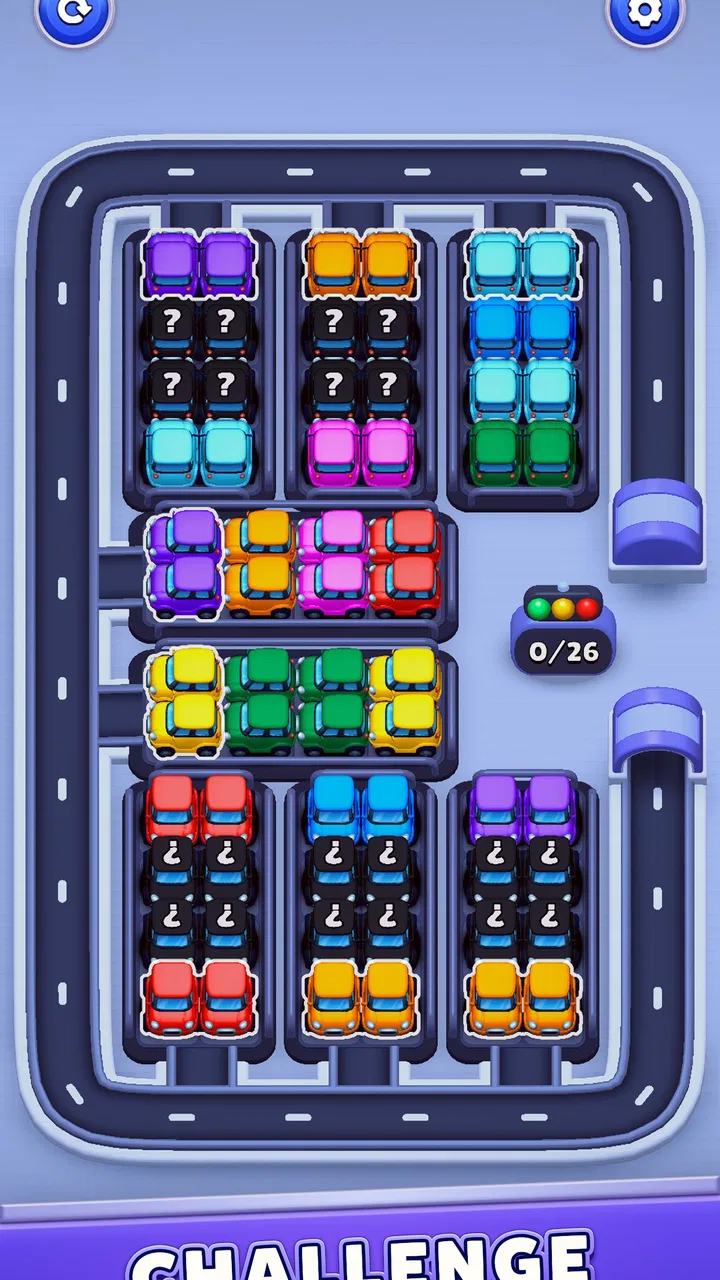
Car Sort: Color Puzzle
- 4.4
- Rating
- 500.00K
- Installs
- Free
- Price

 Analysis by App-foxy
Car Sort: Color Puzzle is the kind of game I open when I want a quick mental reset rather than a dramatic challenge. Its central idea is easy to understand: sort traffic by color, make room on the road, and keep the puzzle moving before the arrangement becomes too crowded. That simplicity is its strongest quality, but it also sets a clear limit. This is a focused casual puzzle game, not a deep strategy experience, and I think it works best when you want short sessions with just enough planning to keep your attention.
After spending time with it, my main impression is that the game succeeds because it turns a familiar sorting task into something more visual and immediately readable. You do not need a long tutorial or a complicated rulebook to begin making decisions. The appeal comes from looking at the current traffic, spotting the safest color sequence, and deciding whether to solve the obvious move or prepare the board for the next one. That small amount of foresight gives the game more substance than its short store summary suggests.
How the traffic-sorting puzzle feels in everyday play
The first thing I noticed is how quickly Car Sort: Color Puzzle gets out of the way. The presentation is built around colored vehicles and lanes, so the goal is visible rather than buried in menus. That makes it especially comfortable for playing in short bursts. I can imagine using it while waiting for an appointment, taking a break between tasks, or winding down before bed without needing to remember a complicated story or a large set of controls.
You May Also Like

 Blood Strike: 2.5 Anniversary
Blood Strike’s Loadouts Turn Every Drop Into a Tactical Gamble
A close look at Blood Strike’s custom loadouts: how fast access to signature weapons reshapes its battle royale rhythm, rewards preparation, and narrows the gap between fights.

 Pandora - Music & Podcasts
Pandora’s Music Is Easy to Start, but Harder to Recover
Pandora’s strength is its low-effort path from a seed to a station. Its weak spot is how much confidence it asks you to place in connection, setup, and quiet recovery.

 8 Ball Pool
 Is Built on Rivalries, Rematches, and Routine
A close look at the rivalries, rematches, shared routines, and unanswered safety questions that turn a quick pool match into a persistent mobile community.

 Samsung Music
’s Quiet Strength Is Playing What You Already Own
Its reach comes less from spectacle than from dependable access to a personal library. That simplicity is both the app’s strongest retention engine and its ceiling.

 AccuWeather: Weather Radar
AccuWeather Review: A Quick, Clear Forecast for Everyday Decisions
For everyday plans, the best forecast is the one you can understand quickly. AccuWeather makes rain timing, radar, and local conditions easy to act on, with a few trade-offs.

 Hill Climb Racing
Why Hill Climb Racing Still Turns Crashes Into One More Run
A tiny car, a bumpy hill and one more upgrade: Hill Climb Racing keeps resurfacing because its simple chaos makes every near-miss feel personal.
More From Our News Desk



The basic rhythm is simple: inspect the traffic, choose a useful move, and try not to block the options that will matter later. A move that looks productive in the moment can create a tight arrangement afterward, so the game rewards patience more than frantic tapping. I found myself looking beyond the immediate match and asking which color would become difficult to access if I used a lane too early. That is where the puzzle starts to feel deliberate rather than purely automatic.
The most important skill is preserving flexibility. When several choices are available, I generally prefer the move that leaves more open routes, even if it does not produce the fastest visible result. This is a useful habit for new players because sorting games often punish the instinct to clear whatever is easiest first. In this title, a neat-looking move can still be a poor move if it places the remaining traffic in an awkward order.
The color-based design also makes the game approachable for people who enjoy visual organization. I do not need to calculate complicated values or memorize special abilities. Instead, I read the board as a changing arrangement. That makes each attempt feel calm at first, while the pressure gradually comes from having fewer convenient choices. The mood is gentler than a timed action game, but it still gives me a reason to stay engaged.
Why the simple rules create worthwhile decisions
Car Sort: Color Puzzle is more interesting when I treat every open space as a resource. It is tempting to think only about the vehicles I want to move, yet the empty positions are just as important. Leaving a useful gap can allow a later color to pass through, while filling that gap too soon may force a less efficient sequence. This is a small but meaningful distinction, and it is one of the reasons the game can hold my attention after the initial novelty fades.
Another practical approach is to identify the color that is currently hardest to reach. Instead of clearing the most visible group, I look for the vehicle or lane that could become trapped behind other traffic. Solving that obstruction first often makes the rest of the board easier to read. It is not a guaranteed solution to every puzzle, but it gives the game a more thoughtful flow and reduces the feeling of making random guesses.
I also recommend pausing for a full board scan before tapping. In a casual puzzle, it is easy to focus on one attractive move and overlook a better sequence nearby. A few seconds of observation can prevent a chain of unnecessary corrections. This is particularly useful for players who normally approach mobile games by reacting quickly. Here, slowing down is not wasted time; it is part of the strategy.
The game is free to play, which makes it easy to try without committing money at the start. There are in-app purchases ranging from around two dollars to around one hundred dollars per item, so anyone who enjoys the core loop should still pay attention to purchase prompts and spending controls. I would not recommend treating the game as completely cost-free in practice if you know you are likely to buy optional items impulsively. The free entry is attractive, but the presence of higher-priced purchases is worth keeping in mind.
Where it fits among other casual puzzle games
Compared with match-three games, this one feels less dependent on creating chains or waiting for a lucky board. My decisions are more positional, and the satisfaction comes from arranging traffic cleanly rather than triggering a large visual reaction. Compared with classic block-placement puzzles, it is more immediately themed and easier to understand at a glance, but it may offer less room for long-term planning if you prefer systems that build into complex combinations.
It also differs from traditional sorting games that use colored tubes, balls, or containers. The traffic theme gives the familiar structure a more active visual identity, and the idea of lanes makes space management feel natural. On the other hand, players who prefer a very minimal interface may find the vehicle presentation less direct than a plain color-and-container design. I like the theme because it gives the sorting task personality, although the underlying appeal remains the same: organize the board without closing off your future choices.
That comparison helps clarify who should install it. If you want a puzzle that can be understood immediately and played without sound, a long narrative, or complex controls, it is a good fit. If you are looking for competitive rankings, elaborate character progression, or a puzzle system that changes dramatically from one session to the next, the usual deeper alternatives may suit you better.
What stands out, and where the experience loses momentum
My strongest positive impression is the balance between accessibility and mild tension. The rules are friendly enough for a first-time player, but the board can still make me reconsider a move. That combination is harder to achieve than it looks. A puzzle that is too simple becomes background noise, while one that is too demanding is inconvenient for casual play. Car Sort: Color Puzzle generally stays in the comfortable middle.
I also appreciate that the game encourages visual planning without requiring a large time commitment. A realistic everyday use case would be a short break during a busy afternoon: I can play one small session, put the phone down, and return to my task without feeling that I have abandoned a long campaign. The game does not ask me to remember a story or maintain a complicated build. Its mental footprint is small, which is exactly what I want from this type of mobile title.
There is a quieter benefit as well. Sorting traffic gives the mind a concrete problem to hold onto, so the game can feel more satisfying than endlessly scrolling through short videos. I would not call it a productivity tool, but it can provide a more active break. The best sessions are the ones where I finish a puzzle feeling that I made a sequence of sensible decisions, not merely that I waited for an animation to complete.
The main weakness is variety. A focused sorting mechanic can be enjoyable for a long time if the layouts remain surprising, but the basic action remains recognizable from session to session. Players who need constant novelty may eventually feel that they are repeating the same mental gesture with different traffic arrangements. That is not a flaw in execution so much as a limitation of the chosen format.
Another point of friction is that the game’s simplicity can make mistakes feel more frustrating than expected. When the rules are easy to understand, a failed attempt is usually the result of one poor decision rather than confusion about what to do. I sometimes reached a difficult position because I had filled a useful space too early. That can be satisfying when I learn from it, but it can also feel restrictive if I wanted a relaxed, consequence-free experience.
The free-to-play structure deserves a balanced mention too. The game is accessible without an upfront charge, but the range of optional purchase prices means families should use the normal safeguards available on their device. The age rating is Everyone, which supports its broad accessibility, yet an Everyone rating does not automatically mean every purchase decision is suitable for every household. I would let a child try the puzzle, but I would still make sure purchase approval is controlled.
Performance expectations are also worth framing realistically. The game is designed for a relatively broad range of devices, with Android support beginning at version 7.0. That makes it approachable for people who are not using a recent phone, although the experience can still depend on the condition and speed of the individual device. I would not choose it because I expect cutting-edge graphics; I would choose it because the visual idea is clear and the interaction is lightweight.
Small habits that make difficult boards easier
My first actionable tip is to avoid clearing a color simply because it is already close to completion. Before committing, I check whether that move removes a useful buffer. A nearly finished group can sometimes wait, while an awkwardly placed color needs attention immediately. This reverses the instinct most people bring to sorting puzzles and often produces a cleaner sequence.
My second tip is to think in two steps instead of one. I ask where the selected vehicle will go and what that destination will prevent afterward. That extra question is enough to catch many avoidable traps. It is especially helpful when two moves appear equally good: I choose the one that keeps the next color accessible rather than the one that merely looks tidy now.
My third tip is to use short sessions intentionally. If I keep playing after I have become impatient, I make faster decisions and lose the careful scanning that the game rewards. Stopping after a frustrating attempt and returning later can be more effective than forcing another round. This is one of the rare mobile puzzles where a break genuinely improves my play because the board becomes easier to see with a fresh mind.
A fourth useful trade-off concerns convenience versus control. If you want a quick distraction, the straightforward rules are ideal. If you want to analyze every possible route, the visual nature of the game may feel less satisfying than a more abstract puzzle with clearly defined mathematical states. I enjoy the former, but I would direct serious puzzle enthusiasts toward a title with deeper systems if their goal is mastery rather than relaxation.
Who should choose it, and who should skip it
I would recommend Car Sort: Color Puzzle to casual players who like color organization, tidy visual layouts, and puzzles that can be learned in moments. It is also a sensible choice for someone who wants a low-pressure game for waiting rooms or commutes, provided they are comfortable with a free-to-play format. The Everyone rating makes it broadly approachable, and the simple traffic theme is easier to share with younger players than a game built around complicated rules or mature subject matter.
I would be more cautious recommending it to players who dislike repeated mechanics. If you need a strong story, a competitive community, or a large collection of distinct gameplay systems, this will probably feel too narrow. The same applies if purchase prompts make you uncomfortable, even when you do not intend to buy anything. In that case, a paid puzzle with a single upfront purchase may provide a cleaner experience.
It is also not my first choice for someone seeking intense challenge from the opening minute. The game’s appeal comes from gradual concentration and manageable decisions, not from overwhelming difficulty. Players who enjoy demanding logic problems may appreciate the planning, but they may also outgrow the format once they have learned how to preserve space and prioritize blocked colors.
Defcob Games has positioned the title as a compact puzzle rather than an expansive game world, and that focus is reflected in how I use it. The current version is 1.1.3, and the game has reached over fifty thousand installs with an average rating of 4.5 from around one thousand seven hundred ratings. Those figures suggest that the straightforward concept has found an audience, while the experience itself remains best judged by whether this particular style of sorting matches your habits.
My final recommendation
Car Sort: Color Puzzle earns my recommendation as a simple, readable traffic-sorting game with more planning than its bright presentation initially implies. I like that it gives me something concrete to solve without demanding a long session, and I value the way empty space, blocked colors, and future routes gradually become part of the decision-making. The best moments come when a messy board suddenly opens because I resisted the obvious move and prepared the right path.
Still, I would not present it as an all-purpose puzzle solution. Its central mechanic can become repetitive, and the free-to-play purchase range means I would approach it with sensible spending controls. Players wanting deep progression or endless mechanical variety should look elsewhere. For everyone else, especially people who enjoy sorting games but want a more lively traffic theme, it is an easy title to try.
My bottom line: choose it for short, thoughtful sorting sessions, not for a huge adventure. The game’s strength is its clarity. I can pick it up, understand the board, make a few careful decisions, and leave with the feeling that I used my attention well. That is a modest goal, but Car Sort: Color Puzzle meets it convincingly enough to deserve a place among casual puzzle games.
FAQs for Car Sort: Color Puzzle
01What is the main objective of Car Sort: Color Puzzle?
Car Sort: Color Puzzle is a captivating puzzle game where the primary objective is to sort cars based on their colors. Players need to strategically move cars to match them with others of the same color, clearing levels and earning points. The game requires logical thinking and planning to efficiently organize the cars in the fewest moves possible.
02Is Car Sort: Color Puzzle free to play?
Yes, Car Sort: Color Puzzle is free to download and play. However, it includes in-app purchases that offer additional features, such as hints or extra moves. These purchases can enhance the gaming experience, but they are entirely optional, allowing players to enjoy the game without spending any money.
03What are the system requirements for Car Sort: Color Puzzle?
Car Sort: Color Puzzle is designed to run smoothly on both Android and iOS devices. For Android, it typically requires version 5.0 or higher, while iOS users should have iOS 10.0 or later. The game is optimized for mobile devices, ensuring quick loading times and a seamless user experience.
04Does Car Sort: Color Puzzle offer multiplayer options?
Car Sort: Color Puzzle is primarily a single-player game focused on individual puzzle-solving. While it does not offer direct multiplayer options, players can compete on leaderboards, comparing their scores with friends or other players globally, adding a competitive edge to the gameplay.
05Are there any ads in Car Sort: Color Puzzle?
Car Sort: Color Puzzle includes ads, which help support the developers and keep the game free for players. Ads are typically displayed between levels or as optional videos for rewards. If players prefer an ad-free experience, they can choose to make an in-app purchase to remove them.
Pros
- Intuitive and easy-to-use interface.
- Challenging puzzles with increasing difficulty.
- Vibrant and appealing graphics.
- Offline mode available for playing anywhere.
- Regular updates with new levels.
Cons
- Contains frequent ads between levels.
- Limited free hints
- prompting in-app purchases.
- Requires patience for complex puzzles.
- Occasional lag on older devices.
- No multiplayer or social features.

Car Sort: Color Puzzle
Gallery